This week, our topic in afternoon seder has been sehitah, squeezing liquid out of a solid on Shabbat. We came across an Eglei Tal that cites a Tosafot from today's Daf Yomi. It seems like Daf Yomi material comes up elsewhere in my day surprisingly often.
The Eglei Tal is “shocked” at the Beit Yosef.
Showing posts with label Shabbat 01. Show all posts
Showing posts with label Shabbat 01. Show all posts
Monday, October 22, 2012

Monday, October 15, 2012
Mistakes about science
Today's daf talks about spontaneously generated lice. There's a dispute among tannai'm whether you can kill a louse on Shabbat (Shabbat 12a, 107b). Rav Yosef explains that the disagreement only applies to insects that "do not reproduce," but killing all other insects is forbidden (107b). The rishonim then discuss which species of insect are generated from sweat, from rot, from dirt, etc., or from eggs. The halakhah concludes that killing lice is permitted.
There are much more dramatic Torah-versus-science issues out there than this one. If you're looking for explosive controversy, you want evolution. If you're looking for out-of-date science in the Talmud, this collection is just a start; Pesahim 94b is a big one in particular. If you're looking for a legal and moral mess, look into organ donation.
But, even if relatively undramatic, the issue of spontaneous generation is centrally important to science versus Halakhah. It's unique as a black-and-white case of a canonized halakhah based on rejected science.
There are much more dramatic Torah-versus-science issues out there than this one. If you're looking for explosive controversy, you want evolution. If you're looking for out-of-date science in the Talmud, this collection is just a start; Pesahim 94b is a big one in particular. If you're looking for a legal and moral mess, look into organ donation.
But, even if relatively undramatic, the issue of spontaneous generation is centrally important to science versus Halakhah. It's unique as a black-and-white case of a canonized halakhah based on rejected science.
Friday, October 12, 2012
The Tur hungers for justice
Fitting that Daf Yomi gets to this agadta the same day we read Parashat Bereshit. From Shabbat 10a:
רב חסדא ורבה בר רב הונא הוו יתבי בדינא כולי יומא הוה קא חליש לבייהו תנא להו רב חייא בר רב מדפתי (שמות יח) ויעמד העם על משה מן הבקר עד הערב וכי תעלה על דעתך שמשה יושב ודן כל היום כולו תורתו מתי נעשית אלא לומר לך כל דיין שדן דין אמת לאמיתו אפילו שעה אחת מעלה עליו הכתוב כאילו נעשה שותף להקדוש ברוך הוא במעשה בראשית כתיב הכא ויעמד העם על משה מן הבקר עד הערב וכתיב התם (בראשית א) ויהי ערב ויהי בקר יום אחד
Thursday, October 11, 2012
The square root of two
The Gemara on Shabbat 8a discusses a kavveret, a round basket made of reeds.
The kavveret can be its own domain:
 |
| A drawing of a kavveret from the Steinzaltz Talmud (PDF) |
The kavveret can be its own domain:
אמר אביי: זרק כוורת לרשות הרבים, גבוהה עשרה ואינה רחבה ששה - חייב, רחבה ששה - פטור. רבא אמר: אפילו אינה רחבה ששה - פטור. מאי טעמא - אי אפשר לקרומיות של קנה שלא יעלו למעלה מעשרה.
Wednesday, October 10, 2012
A house for hobbits
The Gemara on Shabbat 7a quotes the following statement:
Soncino translates:
A diagram might help:
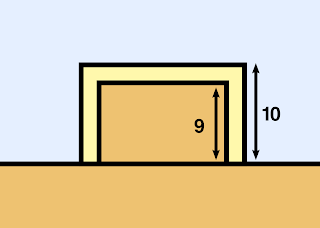
והאמר רב גידל אמר רב חייא בר יוסף אמר רב: בית שאין בתוכו עשרה, וקרויו משלימו לעשרה - על גגו מותר לטלטל בכולו, בתוכו אין מטלטלין בו אלא ארבע אמות.
Soncino translates:
R. Gidal said in the name of R. Hiyya b. Joseph in Rab's name: In the case of a house, the inside of which is not ten [hand breadths in height] but its covering makes it up to ten, it is permitted to carry on the roof over the whole [area]; but within, one may carry only four cubits.
A diagram might help:

Sunday, October 7, 2012
Tractate Shabbat: In and out and in and out...
Massekhet Shabbat discusses, of course, the laws of Shabbat. The beginning of the massekhet is structured chronologically, starting with the laws of Friday afternoon, then candle lighting on Friday evening, then cooking and insulating Friday night. The basics of the 39 melakhot don't come up until the middle of the seventh perek. The rest of the 24 perakim then flow from topic to topic.
But amidst this structure, a surprising topic dominates the first half of the massekhet: hotsa'ah, the melakhah of carrying between a private and public domain. Eight out of the first eleven chapters of the massekhet contain mishnayot about hotsa'ah, and it is the sole topic of five of those chapters: 5, 6, 8, 9, and 11. And most strangely, the very first mishnah of the massekhet is a total non sequitur to the rest of the first perek—a mishnah about, you guessed it, hotsa'ah.
Adding to the surprise, when the Mishnah lists the 39 melakhot in the seventh perek, hotsa'ah is last on the list. And the first Tosafot on the first amud calls it a melakhah geru'ah, an "inferior" melakhah.
So why the focus on hotsa'ah? Why does it get so many chapters? Why is it tacked on to the beginning of the tractate?
But amidst this structure, a surprising topic dominates the first half of the massekhet: hotsa'ah, the melakhah of carrying between a private and public domain. Eight out of the first eleven chapters of the massekhet contain mishnayot about hotsa'ah, and it is the sole topic of five of those chapters: 5, 6, 8, 9, and 11. And most strangely, the very first mishnah of the massekhet is a total non sequitur to the rest of the first perek—a mishnah about, you guessed it, hotsa'ah.
Adding to the surprise, when the Mishnah lists the 39 melakhot in the seventh perek, hotsa'ah is last on the list. And the first Tosafot on the first amud calls it a melakhah geru'ah, an "inferior" melakhah.
So why the focus on hotsa'ah? Why does it get so many chapters? Why is it tacked on to the beginning of the tractate?
Subscribe to:
Posts (Atom)